
Key takeaways:
- Proper sandblasting of bonding surfaces ensures optimal wettability with primer and resin cement.
- The quality of the conditioned surface is determined by the interaction of multiple sandblasting parameters.
- Scientific evidence defines an optimal parameter range for sandblasting zirconium oxide: 0.6–1 bar, 50 µm aluminum oxide, and a 10 mm working distance.
- BASIC prebonder: the first validated system for controlled sandblasting prior to adhesive bonding.
Adhesive bonding of restorations depends fundamentally on surface preparation—specifically, sandblasting. Yet this step remains one of the least controlled processes in many dental practices.
“Sandblast the inner crown surface” may sound like a standardized routine, but in reality it is a highly sensitive physical process. Different devices, fluctuating pressure conditions, varying working distances, and undefined spray cones mean that identical settings do not necessarily produce identical results.
- The problem is not sandblasting itself.
- The problem is the lack of process control.
Sandblasting is not intuitive. Even with identical pressure settings, different devices can deliver varying levels of energy input.
With the BASIC prebonder, a precision sandblasting unit has been developed for the first time specifically for clinical surface conditioning - and scientifically validated.

Why zirconium oxide requires special pretreatment
Unlike silicate ceramics, zirconium oxide does not contain a glass phase and therefore cannot be etched. Adhesion is achieved through micromechanical retention in combination with functional monomers (e.g., MDP).
Surface roughness is only one of several relevant factors. The decisive aspect is the interaction of:
- surface energy (mJ/m²) (wettability)
- surface chemistry
- surface roughness
A prerequisite is a defined surface conditioning via sandblasting with aluminum oxide.
Objectives of conditioning:
- Creation of a reproducible retention structure
- Improved wettability (primer, luting material)
- Preservation of mechanical properties, particularly flexural strength
Sandblasting with aluminum oxide cleans the surface and improves wettability, thereby enhancing adhesion conditions for primers and resin cements.

This is where the challenge lies: the interaction of multiple parameters is decisive.
- blasting pressure
- distance between nozzle and surface
- spray cone and particle distribution
- blasting media (particle size and purity)
Sandblasting prior to bonding is not just a technical step—it is a materials science–defined process.
Sandblasting zirconium oxide: Which parameters are critical?
Materials science studies conducted at the Department of Prosthodontics, LMU Munich, define a clear parameter range for sandblasting zirconium oxide:
- Pressure: 0.6–1.0 bar
- Particle size: 50 µm aluminum oxide (Al₂O₃)
- Working distance: 10 mm between nozzle and surface
Within this range, a surface roughness is achieved that enables stable bond strength while preserving the material.
The challenge in everyday clinical practice: these parameters have been difficult to control.
The underestimated factor: energy input and distance
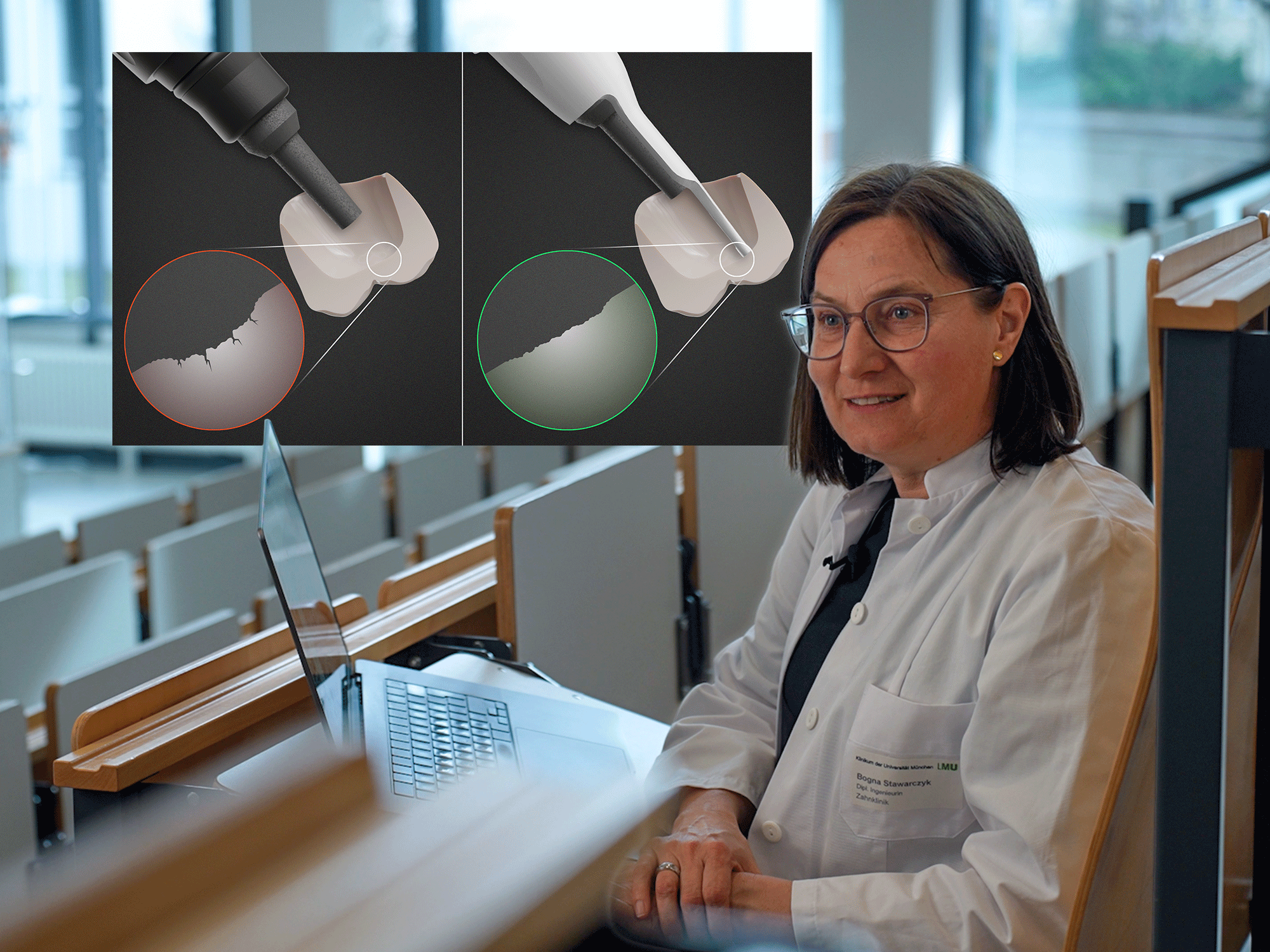
During sandblasting, microscopic aluminum oxide particles impact the surface at high velocity. The energy input per unit area depends not only on pressure but also critically on the distance between nozzle and surface.
A distance that is too small may lead to:
- excessive surface roughness
- microstructural damage
- potential reduction in flexural strength
Pressure settings alone do not guarantee controlled surface conditioning.
Why conventional sandblasting units may be unsuitable for adhesive bonding
Zirconium oxide and high-performance ceramics are relatively recent materials in dentistry. At the same time, adhesive bonding has introduced a paradigm shift—from purely mechanical retention to controlled adhesion mechanisms.
Most sandblasting units in use today originate from dental laboratory applications. They were designed for general tasks such as material removal, cleaning, or surface treatment—not for precise surface conditioning within a narrow physical parameter window.
This mismatch becomes evident particularly with zirconium oxide, where bonding relies on a defined retention structure.
Typical limitations of conventional devices
- Coarse pressure adjustment ranges, preventing fine control within 0.6–1 bar
- No defined working distance, making energy input dependent on manual handling
- Nozzle designs optimized for maximum removal rather than controlled surface transformation
- No means to verify actual energy input at the surface
Adhesive technology requires a level of precision for which many conventional devices were never designed.
Sandblasting is a system process—not an isolated pressure value
All-ceramic materials are sensitive. Their surfaces react strongly to changes in energy input.
The pressure setting is only one variable within a complex system. Differences in media preparation, flow rate, or nozzle characteristics can result in different energy transfer despite identical pressure readings.
Additional influencing factors include:
- moisture in the system
- partial nozzle blockages altering media flow
Equal pressure does not mean equal effect. What matters is the actual energy delivered per unit area—not the manometer reading.
This is precisely where the BASIC prebonder comes in. It transforms sandblasting from an experience-based procedure into a structurally defined system—e.g., via a controlled Venturi mixing chamber ensuring a consistent and homogeneous media flow.


